
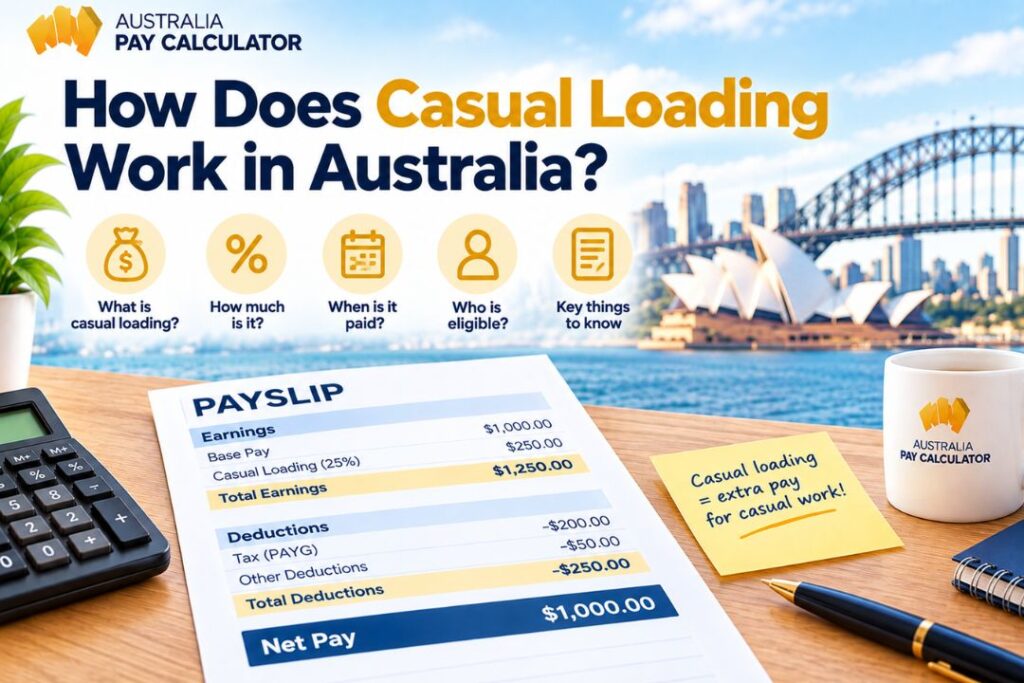
Casual workers in Australia often receive a higher hourly rate than permanent employees. The reason is casual loading, an extra amount added to the ordinary hourly rate to compensate for some paid entitlements that casual employees generally do not receive.
For many casual employees, the loading is 25% of the applicable minimum hourly rate. However, the exact rate can depend on the award, enterprise agreement, or employment arrangement that covers the job.
Understanding casual loading is important when checking a job offer, reading a payslip, or working out how much you should receive for your hours. Here is what it means and how to calculate it.
What Is Casual Loading?
Casual loading is an additional amount paid to eligible casual employees on top of their ordinary hourly rate.
Casual employees generally do not receive the same paid leave benefits as full-time and part-time employees. The casual loading helps compensate for some of those differences.
Under many Australian awards, the casual loading is 25% of the ordinary minimum hourly rate.
For example, if the ordinary hourly rate is $30:
$30 × 25% = $7.50
The casual rate would be:
$30 + $7.50 = $37.50 per hour
The 25% figure is common, but it should not be treated as a universal rate for every job. Your applicable award or agreement determines the rate and how it is applied.
Why Do Casual Employees Get Casual Loading?
Casual employment has different conditions from permanent employment.
A casual employee generally does not receive paid annual leave or paid personal/carer’s leave in the same way as a full-time or part-time employee. Casual loading is designed to compensate for some of these differences.
This means a casual worker may receive more money per hour but have fewer paid leave benefits.
For example, imagine two employees doing similar work:
- Permanent employee: $30 per hour
- Casual employee: $37.50 per hour
The casual employee receives a higher hourly rate because the casual rate includes the 25% loading.
This does not mean the casual employee is simply receiving a bonus. The higher rate is connected to the different employment conditions.
How Is Casual Loading Calculated?
The basic calculation is straightforward when a 25% loading applies.
Ordinary hourly rate × 25% = casual loading
Then:
Ordinary hourly rate + casual loading = casual hourly rate
Example: $28 Per Hour
Suppose the ordinary hourly rate is $28.
First, calculate 25%:
$28 × 0.25 = $7
Then add the loading:
$28 + $7 = $35
The casual rate would be $35 per hour.
Example: $32 Per Hour
If the ordinary rate is $32:
$32 × 0.25 = $8
Then:
$32 + $8 = $40
The casual employee would receive $40 per hour for ordinary hours if the 25% loading applies.
How Does Casual Loading Affect Your Weekly Pay?
Once you know your casual hourly rate, you can calculate your gross weekly pay by multiplying it by the number of hours worked.
For example, assume your casual rate is $37.50 and you work 20 hours:
$37.50 × 20 = $750
Your gross weekly pay would be $750 before tax.
If you work 30 hours:
$37.50 × 30 = $1,125
Your gross weekly pay would be $1,125 before tax.
Your actual take-home pay will be lower after applicable tax and other deductions.
How Does Casual Loading Work With Penalty Rates?
Casual employees may also receive penalty rates for working at certain times or on certain days. These can include evenings, weekends, public holidays, or other periods covered by the relevant award.
The way casual loading interacts with penalty rates depends on the applicable award or agreement. In some awards, the casual rate already incorporates the loading when the penalty rate is applied.
For example, an award may provide a higher percentage for Sunday work for casual employees, with the casual loading already included in that rate.
This is why you should not simply add 25% again to every penalty rate. Check the rate that applies to your specific job.
How Does Casual Loading Work With Overtime?
Casual employees can be entitled to overtime payments.
The overtime rules depend on the award, enterprise agreement, or other industrial instrument covering the employee. Some awards specify that the casual loading does not apply separately to overtime hours, while the overtime rate itself is set out in the applicable rules.
For example, if your ordinary casual rate is $37.50, you should not automatically assume that your overtime rate is simply $37.50 plus another 25%.
The correct overtime rate needs to be checked against the applicable award or agreement.
How Do You Calculate Casual Pay Step by Step?
If you want to check your casual pay, follow these steps.
Step 1: Find Your Ordinary Base Rate
Start by finding the ordinary hourly rate that applies to your classification.
This may come from an award, enterprise agreement, or employment arrangement.
Step 2: Check the Casual Loading
Check whether a 25% casual loading applies.
Many awards use a 25% loading, but the applicable industrial instrument should be checked before calculating your pay.
Step 3: Calculate the Loading
Multiply the ordinary hourly rate by 0.25.
For a $30 base rate:
$30 × 0.25 = $7.50
Step 4: Add the Loading
Add the loading to the base rate:
$30 + $7.50 = $37.50
Your ordinary casual rate is therefore $37.50 per hour.
Step 5: Multiply by Your Hours
If you work 25 hours:
$37.50 × 25 = $937.50
Your gross pay would be $937.50 before tax and other deductions.
Step 6: Check Other Rates
Finally, check whether any of your hours qualify for overtime, weekend, public holiday, shift, or other penalty rates.
Do not use your ordinary casual rate for every hour if different rates apply.
What Is the Casual Minimum Wage in Australia?
The minimum wage depends on the type of employment and the industrial instrument that applies.
From 1 July 2026, the National Minimum Wage for adult employees not covered by an award or registered agreement is $26.44 per hour. The casual rate is $33.05 per hour, which includes the 25% casual loading.
This provides a useful example of how casual loading works:
$26.44 × 25% = $6.61
$26.44 + $6.61 = $33.05
However, many employees are covered by awards, which can have higher minimum rates based on the industry, occupation, classification, age, experience, and other conditions.
Does Casual Loading Affect Take-Home Pay?
Yes, the higher casual hourly rate can increase your gross earnings for the hours you work. However, casual loading is part of your pay, so it can also form part of the income considered when calculating tax.
For example, if your casual rate is $37.50 and you work 20 hours, your gross pay is $750.
$37.50 × 20 = $750
Your take-home amount will depend on your tax position and any other deductions.
This is why your hourly casual rate and your final amount in the bank are not necessarily the same.
Frequently Asked Questions
Is casual loading always 25% in Australia?
A 25% casual loading is common under Australian awards, but the exact pay rate depends on the award, agreement, or employment arrangement covering your job. Always check the applicable rate.
Do casual employees get annual leave?
Casual employees generally do not receive paid annual leave in the same way as full-time and part-time employees. Casual loading helps compensate for some entitlements they generally do not receive.
Do casual employees get superannuation?
Generally, casual employees are entitled to superannuation under the applicable superannuation rules. Casual employment does not automatically remove an employee’s superannuation entitlement.
Can casual employees receive penalty rates?
Yes. Casual employees may receive penalty rates for certain hours or days, depending on the award or agreement that applies to their employment. The exact calculation varies between awards.
How do I calculate 25% casual loading?
Multiply the ordinary hourly rate by 0.25 to find the loading. Then add that amount to the ordinary rate. For example, $30 × 0.25 = $7.50, making the casual rate $37.50.
Final Thoughts
Casual loading gives eligible casual employees an additional amount on top of their ordinary hourly rate. In many Australian awards, this loading is 25%, although the exact rules depend on the award, agreement, or employment arrangement. To check your pay, start with the correct base rate, calculate the applicable loading, and then check whether overtime or penalty rates apply to particular hours. Remember that casual loading is part of your pay and is not simply an extra bonus. Once you understand how the rate is built, it becomes much easier to check your hourly wage, weekly earnings, and payslip.
Calculate Your Casual Pay
Want to see how your casual rate affects your regular earnings? Use the Australian Pay Calculator to estimate your pay and understand your income across different pay periods.