
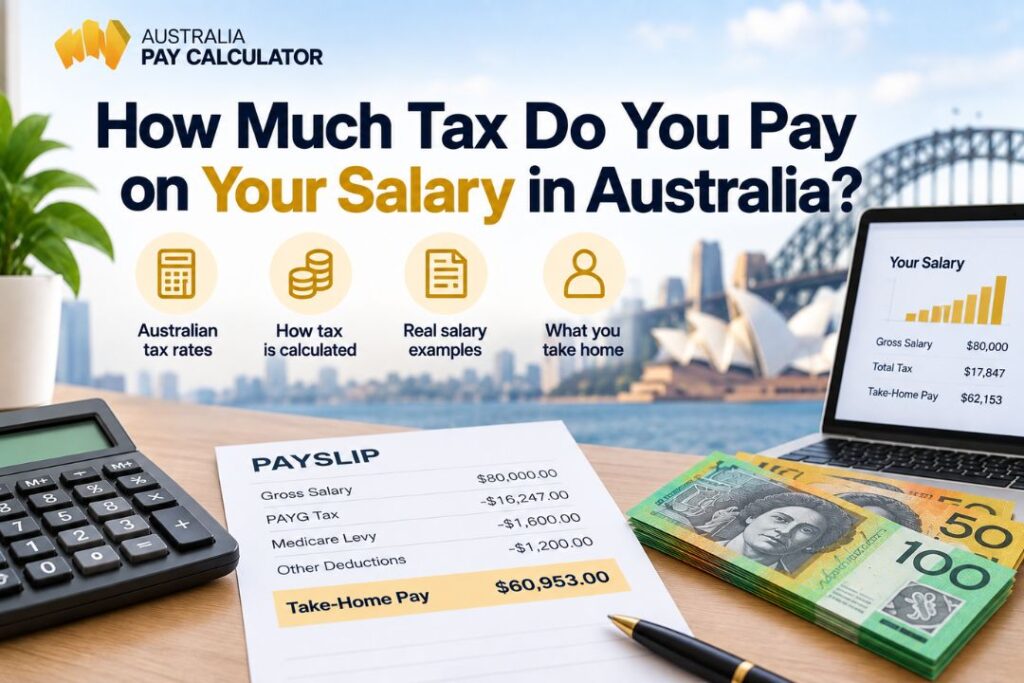
Your salary can look good on paper, but the amount that reaches your bank account is usually lower.
In Australia, how much tax you pay on your salary mainly depends on your taxable income. Australian residents can earn up to $18,200 tax-free, then higher tax rates apply as income rises. For 2026–27, resident income tax rates range from 15% to 45%.
The important thing to know is that your whole salary is not taxed at your highest rate. Different parts of your income are taxed at different rates.
Here is how it works.
How Much of Your Salary Goes to Tax in Australia?
Australia uses a progressive income tax system.
This means your salary is split across different tax brackets. Each part is taxed at the rate that applies to that bracket.
For example, if you earn $80,000 a year, you do not pay 30% tax on the full $80,000.
Instead:
- The first $18,200 is tax-free
- Income from $18,201 to $45,000 is taxed at 15%
- Income from $45,001 to $80,000 is taxed at 30%
Your employer will usually deduct tax from each pay through the PAYG withholding system and send it to the Australian Taxation Office.
At the end of the financial year, your final tax position is worked out when your total taxable income is assessed.
If you want to see what may actually reach your bank account, the Take Home Pay Calculator can help you estimate your weekly, fortnightly, monthly and annual pay after tax.
Australian Salary Tax Rates for 2026–27
For Australian residents claiming the full tax-free threshold, the 2026–27 tax rates are:
| Taxable income | Tax rate |
| $0 to $18,200 | No tax |
| $18,201 to $45,000 | 15% on each $1 over $18,200 |
| $45,001 to $135,000 | $4,020 plus 30% on each $1 over $45,000 |
| $135,001 to $190,000 | $31,020 plus 37% on each $1 over $135,000 |
| Over $190,000 | $51,370 plus 45% on each $1 over $190,000 |
From 1 July 2026, the tax rate on income between $18,201 and $45,000 fell from 16% to 15%.
The main point is that moving into a higher tax bracket does not mean your whole salary is suddenly taxed at the higher rate.
For example, if you earn $100,000, only the part of your income above $45,000 is taxed at 30%.
This is why your highest tax rate isn’t the same as the average percentage of your total salary you pay in tax.
How Much Tax Do You Pay on Different Salaries?
A few real salary examples make the system easier to understand.
The figures below show basic income tax for Australian residents claiming the full tax-free threshold. They do not include the Medicare levy, HELP repayments, tax offsets or personal deductions.
| Annual salary | Estimated income tax | Salary after income tax |
| $50,000 | $5,520 | $44,480 |
| $60,000 | $8,520 | $51,480 |
| $80,000 | $14,520 | $65,480 |
| $100,000 | $20,520 | $79,480 |
| $120,000 | $26,520 | $93,480 |
| $150,000 | $36,570 | $113,430 |
These examples show why simply multiplying your salary by your highest tax rate gives the wrong result.
A person earning $100,000 is in the 30% tax bracket, but their basic income tax is about $20,520, not $30,000.
Your actual take-home pay can be lower because income tax is not always the only amount that affects your final pay.
What Can Change Your Salary After Tax?
Two people with the same gross salary may not always receive the same take-home pay.
That is because other taxes, repayments and personal circumstances can affect the final amount.
Medicare Levy
Most Australian taxpayers also pay a Medicare levy of 2% of taxable income.
This is separate from the standard income tax rates.
For example, someone earning $100,000 may pay about $20,520 in basic income tax. A standard 2% Medicare levy would add about $2,000, taking the combined amount to around $22,520 before other adjustments.
Some lower-income earners may qualify for a reduced Medicare levy or an exemption.
HELP and Study Loan Repayments
If you have a HELP or another eligible study and training loan, compulsory repayments may also reduce your take-home salary.
The amount depends on your repayment income and the rules applying in that financial year.
Other things that may change your final take-home pay include:
- Work-related deductions
- Tax offsets
- Bonuses and commissions
- Income from a second job
- Salary sacrifice arrangements
- Medicare levy reductions or exemptions
- Other taxable income
This is why two people earning exactly the same salary may still have different final tax outcomes.
How to Work Out Your Salary After Tax
You can calculate salary tax manually by applying each tax bracket separately.
Suppose your taxable salary is $90,000.
The calculation would be:
- First $18,200 = $0 tax
- Next $26,800 at 15% = $4,020
- Remaining $45,000 at 30% = $13,500
- Total basic income tax = $17,520
If a standard 2% Medicare levy applies, that would add another $1,800.
That leaves about $70,680 per year after basic income tax and Medicare levy, before any HELP repayment, tax offset or other adjustment.
You can also use the Australian Pay Calculator to estimate your tax and see your salary as weekly, fortnightly, monthly or annual take-home pay without working through each bracket manually.
Frequently Asked Questions
Do you pay tax if you earn less than $18,200 in Australia?
Australian residents who can claim the full tax-free threshold generally pay no income tax on taxable income up to $18,200. Different rules may apply depending on residency status and personal circumstances.
Is income tax different in each Australian state?
No. Individual income tax is charged under the federal tax system, so the main resident tax brackets are generally the same across Australia regardless of which state or territory you work in.
Will earning more money mean all my salary is taxed more?
No. Only the part of your income above a new tax threshold is taxed at the higher rate. The income below that threshold continues to be taxed at the lower applicable rates.
Is super included when calculating tax on salary?
It depends on your employment package. Employer super may be paid on top of your salary or included in a total remuneration package, so always check how your salary offer is structured.
Conclusion
So, how much tax do you pay on your salary in Australia? There is no single percentage for everyone. Your taxable income moves through different tax brackets, starting with the $18,200 tax-free threshold. The Medicare levy, HELP repayments, deductions, and other personal factors can then change the amount you finally keep.
The easiest way to understand your real pay is to look beyond your gross salary. Use the Australian Pay Calculator to estimate your tax and see what your income may look like after tax each week, fortnight, month or year.